
Stripe vs Helcim vs Square (2025 Comparison): Which Payment Processor Offers the Best Value?
Choosing the right credit card processor in 2025 can mean the difference between keeping or losing hundreds in fees each month. For freelancers, small businesses, and growing eCommerce brands, Stripe, Helcim, and Square are the three giants of modern payment processing but each shines in different ways.
In this deep-dive, we tested them across fees, payout times, ease of setup, and best use cases to help you decide which one truly fits your business needs this year. 2025 at a Glance: The Top Payment Platforms for Freelancers.
Why This Comparison Matters in 2025
Payment processing has evolved and so have the fees.
Interchange rates are shifting, businesses are going hybrid, and instant payouts have become the expectation.
Yet many business owners still stick to outdated setups that silently eat into margins. Stripe, Helcim, and Square now cater to different business sizes and models, but they’re not interchangeable.
Top Tip: Before comparing processors, calculate your effective fee per $1,000 in sales. The difference between 2.6% and 2.9% might seem small but adds up to $300+ in annual costs for many freelancers and SMEs.
Quick Comparison Table: Stripe vs Helcim vs Square (2025)
The table below shows estimated outcomes based on typical SMB card mixes. Actual rates vary, but the pattern highlights where flat-rate simplicity gives way to interchange-plus savings as volume grows.
| Processor | Pricing Model | Transaction Fees | Payout Speed | Best For | Monthly Fee |
|---|---|---|---|---|---|
| Stripe | Flat-rate / Custom | 2.9% + $0.30 | 2–3 days / Instant | SaaS, freelancers, global payments | None |
| Helcim | Interchange-plus | Interchange + 0.5% + $0.25 | 1–2 days | Transparent pricing for SMBs | None |
| Square | Flat-rate | 2.6% + $0.10 | Next-day / Instant | POS & small retailers | None |
Why your effective rate may be higher than advertised: Advertised rates don’t always reflect what businesses actually pay. Effective rates vary based on card type, transaction method, and whether pricing is flat-rate or interchange-plus, which is why higher-volume businesses often see lower real costs with interchange-plus models over time.
Flat-rate pricing looks simple, but it isn’t always the cheapest option as volume grows. This is why many cost-conscious businesses compare flat-rate models with interchange-plus pricing to understand where real savings begin.
Which Is Cheapest at $5k, $10k, and $25k Per Month?
At lower volumes (under $3,000 per month), Stripe and Square’s flat-rate pricing is usually comparable and easier to manage. Once monthly volume exceeds $5,000–$10,000, Helcim’s interchange-plus model typically becomes cheaper, especially for businesses accepting rewards or corporate cards. At higher volumes, the savings gap tends to widen further in Helcim’s favor.
Stripe Overview: Best for Global Businesses & Developers
Stripe remains the go-to payment processor for digital-first businesses and freelancers handling global clients. Its developer-friendly API and strong integration network (Shopify, QuickBooks, Xero, WooCommerce) make it incredibly flexible.
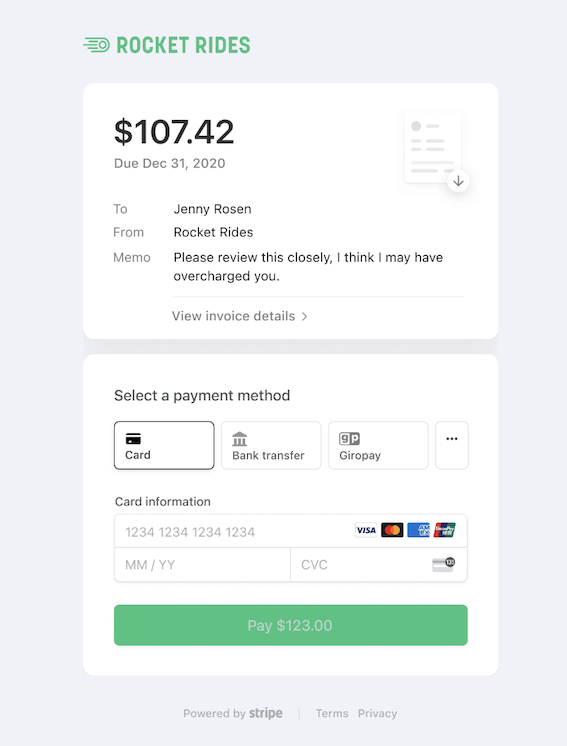
Stripe hosted invoice payment page used for freelancer and small-business billing (demo environment).
Key Benefits
Works in 40+ countries and 135+ currencies
Instant Payouts available in select markets
Ideal for subscription-based or SaaS invoicing
Seamless API integrations
Drawbacks
Slightly higher flat-rate fees
Instant payouts add 1% surcharge
May feel overkill for local service businesses
Top Tip: Stripe is unbeatable if your clients are international as its built-in currency conversion beats most banks by 1–2% on exchange rates.
Helcim Overview: Best for Transparent Pricing & Growing Businesses
If transparency and low fees matter most, Helcim is the standout choice in 2025. It’s known for its interchange-plus model, meaning you see exactly what card networks charge plus a small markup.
Unlike Stripe and Square, Helcim doesn’t penalize you for using high-end cards, and you automatically qualify for lower rates as you scale.
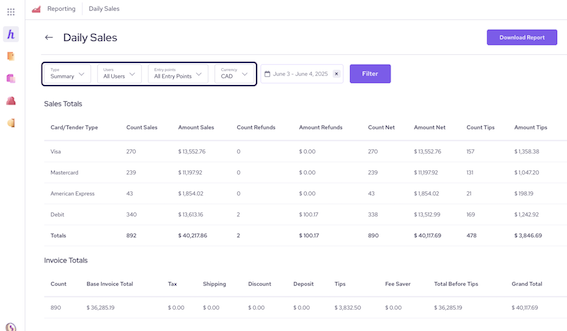
Helcim merchant dashboard showing daily sales and payment reporting (demo environment).
Key Benefits
Interchange-plus pricing (the most transparent model)
No setup, PCI, or cancellation fees
Volume-based discounts for scaling businesses
Advanced reporting + customer management features
Drawbacks
Not ideal for ultra-low monthly volume (< $1k)
Slightly longer setup process
| Monthly Volume | Est. Effective Rate | Monthly Savings vs Stripe |
|---|---|---|
| $2,000 | ~2.6% | ~$6 |
| $10,000 | ~2.4% | ~$50 |
| $25,000 | ~2.2% | ~$150 |
Top Tip: If your card volume exceeds $5,000/month, Helcim’s interchange-plus pricing can cut annual fees by up to 15%.
Square Overview: Best for Simplicity & Point-of-Sale (POS)
Square shines for brick-and-mortar businesses, mobile sellers, and independent freelancers who prefer plug-and-play simplicity. You get free POS software, quick setup, and next-day payouts and no coding or developer help needed.
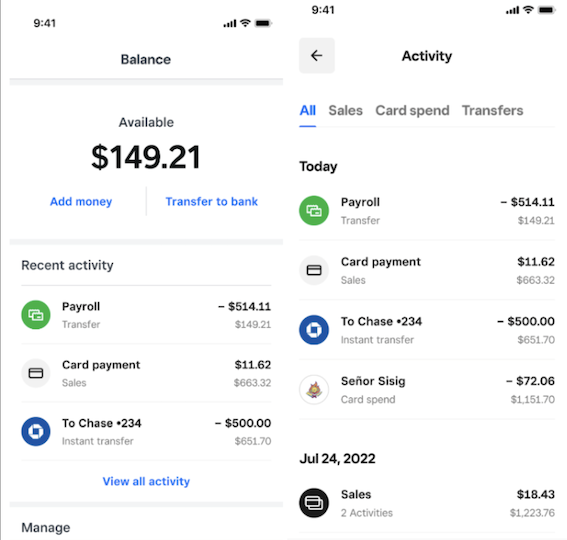
Square mobile app showing balance, card payments, and payout activity (demo environment).
Key Benefits
Free POS app & reader
Flat, predictable fees
Works with Apple Tap-to-Pay
Instant setup with no underwriting
Drawbacks
Higher effective rate for large volumes
Limited transparency (no interchange detail)
Advanced features may require paid add-ons
Top Tip: Square is unbeatable for “swipe and go” simplicity and perfect for local freelancers, small shops, and market vendors.
Choosing the Right Processor for Your Business Type
| Business Type | Best Processor | Why |
|---|---|---|
| Freelancers / Creators | Stripe | Easy invoicing + global payments |
| Small Retail / Service | Square | Instant setup + free POS |
| High-Volume SMBs | Helcim | Interchange-plus savings |
| SaaS / Subscription | Stripe | Recurring billing automation |
| Multi-location Retail | Square | Hardware + reporting |
| Agency / Consulting | Helcim | Transparent pricing & discounts |
Best Choice for Freelancers vs Growing Small Businesses
Freelancers and solo operators often prefer Stripe or Square for fast setup, predictable fees, and simple invoicing. Growing small businesses processing consistent volume usually benefit more from Helcim’s transparent interchange-plus pricing as costs scale.
Payment processor needs vary widely between freelancers, retail sellers, and growing service businesses. Comparing processors by business type helps narrow down which platforms align best with transaction size, sales channels, and growth stage.
Our Verdict: Which Wins in 2025?
Stripe dominates for global reach and developer tools.
Helcim wins on transparency and cost-efficiency.
Square stays unbeatable for small business simplicity.
If you’re a freelancer or growing small business:
Start with Square for instant setup.
Move to Helcim once you cross $5,000–10,000/month.
Add Stripe if you sell subscriptions or global services.
While no single processor is cheapest for every business, reviewing the lowest-cost credit card processing options can help small businesses avoid overpaying as volume increases.
ScaleUp Tip
Combine Helcim for regular clients and Square for ad-hoc work.
Use Stripe for global payments or SaaS invoicing.
This blended approach maximizes convenience and cost savings.
FAQs: Stripe vs Helcim vs Square (2025 Edition)
Q1. Which payment processor is cheapest overall?
Helcim usually wins for consistent volume thanks to interchange-plus pricing.
Q2. Which one offers instant payouts?
Square and Stripe both support instant payouts (with a small fee).
Q3. Which is easiest to set up?
Square- instant approval, no developer setup.
Q4. Which processor is best for freelancers?
Stripe is best for online freelancers; Helcim for high-volume professionals.
Q5. Can I use more than one processor?
Yes - many small businesses combine Stripe + Helcim for flexibility and redundancy.
