
Best Credit Card Processors for Freelancers & Creators in 2026

Originally published on November 26, 2025. Last updated on February 22, 2026.
Freelancers and digital creators are completely redefining how work and payments happen in 2026. From designers and consultants to online educators and musicians, millions of self-employed professionals now rely on fast, affordable, and transparent payment processing to keep their businesses running smoothly.
With dozens of platforms claiming to offer the lowest fees or instant payouts, it is incredibly tough to know which one is truly built for the unique needs of a solo business owner.
In this article, we break down the best credit card processors for freelancers and creators. We analyze transaction fees, payout times, integrations, and specific use cases so you can pick the right solution and keep more of your hard-earned money.
Why Freelancers & Creators Need Specialized Processing
Freelancers do not just need a way to accept payments; they need ultimate flexibility. Unlike traditional brick-and-mortar merchants who ring up consistent daily sales, freelancers often face unique financial hurdles:
Inconsistent Cash Flow: You might have a $10,000 month followed by a $1,000 month, making expensive monthly software subscriptions a dangerous financial drain.
Global Client Bases: Working with international clients means navigating currency conversions and cross-border fees that can secretly eat up to 3% of your invoice.
The Need for Speed: Waiting three to five business days for a payout is a dealbreaker when you have software subscriptions, contractors, and personal bills to pay.
Predictable Pricing: High fees can erode profits instantly.
Top Tip: When comparing processors, you must always calculate your effective rate. This includes the base card fees, instant payout fees, and foreign exchange markups, not just the headline percentage advertised on the pricing page.
If you’re just starting out and want a broader overview, check out our Ultimate Guide to Card Processing for Small Businesses (2025 Edition).
Flat-Rate vs. Interchange-Plus: Which Is Better for You?
Before choosing a platform, you need to understand how these companies make their money. There are two primary pricing models in 2026.
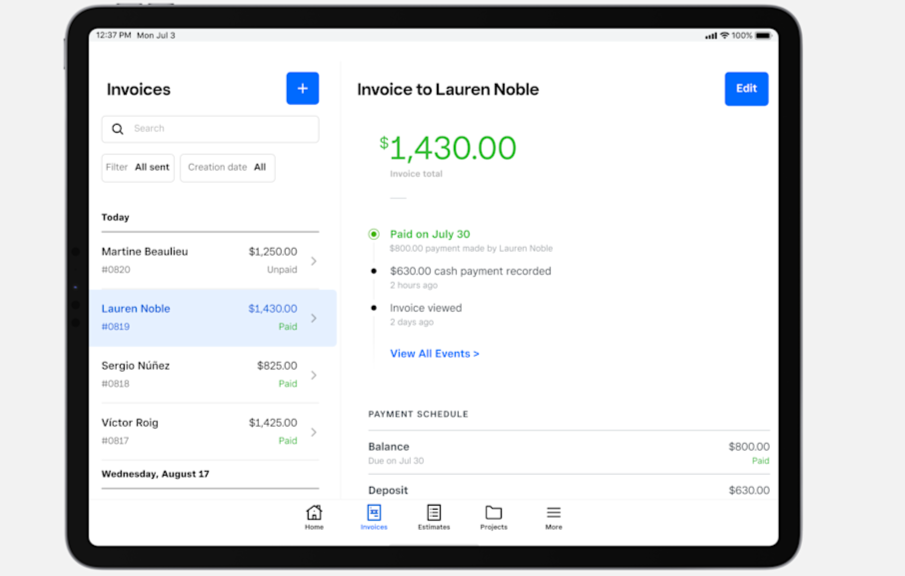
Square's mobile invoicing app allows freelancers to easily track client payments, send estimates, and monitor project balances on the go.
Flat-Rate (Stripe, Square, PayPal)
This is the most common model for beginners. You pay the exact same percentage no matter what type of credit card your client uses.
Pros: It is incredibly easy to understand. There are no monthly surprises, making it ideal for freelancers with small or irregular transaction volumes.
Cons: You are paying a premium for that simplicity. The processor charges you a higher blended rate to cover their own costs, meaning you never get to benefit when a client uses a low-fee card like a basic debit card.
Interchange-Plus (Helcim)
This is a transparent, wholesale model. You pay the actual base cost of the credit card transaction, which is set by Visa or Mastercard, plus a very small, fixed markup that goes to the processor.
Pros: This provides a clear breakdown of your real costs. It is typically much cheaper for large invoices and high-volume freelancers.
Cons: The fees vary depending on the exact card your client uses, making it slightly more complex to forecast exact penny-for-penny costs.
Top Tip: If you consistently bill over $5,000 a month, switching from a flat-rate processor to an interchange-plus model can save you hundreds of dollars in hidden markup fees annually.
To see exactly how the break-even math plays out at different volume levels, check out our complete Stripe vs. Helcim vs. Square comparison.
Best Credit Card Processing Options for Freelancers (2026 Quick Compare)
| Processor | Transaction Fees | Payout Time | Best For | Monthly Fee |
|---|---|---|---|---|
| Square | 2.6% + $0.10 | Next-day | Occasional invoicing | None |
| Stripe | 2.9% + $0.30 | 2–3 days / instant (paid) | Global payments | None |
| PayPal | 2.99% + fixed fee | Instant (with fee) | International clients | None |
| Helcim | Interchange + 0.5% + $0.25 | 1–2 days | Transparent pricing | None |
| Wise | 0.5–1% | Same-day (multi-currency) | Global freelancers | None |
| Payhip | 5% (free plan) | Instant (via Stripe/PayPal) | Selling digital downloads | None |
| Sellfy | 0–2% (paid tiers) | Instant (via PayPal/Stripe) | Course or asset sellers | From $19/mo |
The Best Credit Card Processors by Freelance Type (2026 Deep Dive)
Stripe: Best for Developers and Retainer Consultants
Stripe remains the powerhouse for online-first businesses. If you build websites, run a SaaS product, or handle complex recurring billing for retainer clients, Stripe is the gold standard.
2026 Online Fees: 2.9% + 30¢ per transaction for domestic cards.
The Catch: Stripe charges a 1.5% premium for international cards. Furthermore, if a client disputes a charge, Stripe hits you with a $15 dispute fee.
Square: Best for Occasional Invoicing and Creatives
Square is incredibly popular for graphic designers and local creatives because the setup is instantaneous and requires absolutely no coding knowledge.
2026 Online Fees: Square recently adjusted their free plan pricing. Online transactions now cost 3.3% + 30¢ if you are not paying for a monthly subscription.
The Catch: While the software is remarkably easy to use, that 3.3% rate is one of the highest base fees on the market for online invoices.
PayPal: Best for Client Trust and Global Familiarity
PayPal is the legacy giant. Many freelancers keep it active simply because clients trust the brand and feel comfortable paying through it.
2026 Online Fees: Standard online credit and debit card payments cost 2.99% + 49¢. If the client uses the branded PayPal Checkout button, the fee jumps to 3.49% + 49¢.
The Catch: PayPal is undeniably expensive for domestic transactions, and freelancers frequently report sudden account freezes if the algorithm detects unusual volume spikes.
Helcim: Best for High-Ticket Coaches and B2B Service Providers
Helcim is the disruptor for established freelancers. They offer transparent interchange-plus pricing with zero monthly fees. If you are a business coach charging $3,000 per engagement, this is where you need to be.
2026 Online Fees: You pay the wholesale interchange rate plus a margin of 0.50% + 25¢ per online transaction.
The Catch: Interchange rates fluctuate. A premium rewards credit card will cost you more to process than a standard bank debit card.
Wise: Best for Cross-Border Freelancers
If you live in the US but have clients in Europe or Asia, standard processors will crush you with foreign exchange markups. Wise allows you to accept local bank transfers in multiple countries.
2026 Fees: They charge incredibly low currency conversion fees, typically ranging from 0.5% to 1%, and offer same-day payouts in many currencies.
Payhip & Sellfy: Best for Digital Product Sellers
If you sell eBooks, Notion templates, or video courses, you need a platform that handles digital delivery and global taxes.
Payhip: Offers a forever-free plan with a 5% transaction fee. Crucially, they act as the merchant of record to handle EU VAT compliance automatically.
Sellfy: Operates on a subscription model starting around $19 a month, but they take 0% to 2% in transaction fees on their paid tiers, making them great for higher-volume creators.
If you are strictly selling digital assets and courses, dive into our dedicated guide covering the best payment platforms for digital creators to see a full breakdown of storefront features.
Comparison Snapshot: What You’ll Pay Per $1,000 Processed
To make this concrete, here is what it costs to process a single $1,000 invoice online using the standard 2026 rates for domestic cards.
| Processor | Pricing Model | Estimated Fee on $1,000 | Best Fit For |
|---|---|---|---|
| Helcim | Interchange + 0.50% + 25¢ | ~$23.25 (varies by card) | High-ticket B2B invoices |
| Stripe | 2.9% + 30¢ | $29.30 | Tech-savvy consultants |
| Square (Free Plan) | 3.3% + 30¢ | $33.30 | Quick, occasional invoices |
| PayPal (Standard) | 2.99% + 49¢ | $30.39 | International client trust |
Note: Helcim's fee is an estimate based on an average 1.8% wholesale interchange rate. Your exact fee will depend on the specific credit card your client uses.
ScaleUp Tip
Freelancers and creators should never feel forced to choose between simplicity and savings. As your business matures, the smartest financial move is to use a dual setup.
Use Helcim or Stripe as your primary engine for massive client invoices and recurring retainer retainers to keep your percentage fees as low as possible. Simultaneously, run your digital product sales through Payhip or Sellfy so you do not have to personally manage the nightmare of international digital tax compliance. Finally, keep a Wise account open specifically for routing payments from cross-border clients. This combination minimizes your overhead costs while giving you maximum flexibility across all your income streams.
FAQs
Q1. What is the cheapest way for freelancers to accept credit cards?
The cheapest option depends on your volume and client base. For small invoices, Square and Payhip work best. For consistent higher volume, Helcim’s interchange-plus pricing is more cost-effective.
Q2. Which payment processors offer instant payouts?
PayPal, Square, and Stripe offer instant payouts (often with a 1% fee). Wise supports same-day transfers in many currencies.
Q3. Can freelancers pass credit card fees onto clients?
Yes, but check local laws. Most freelancers add a processing surcharge or discount for ACH payments.
Q4. What’s the best processor for global clients?
Wise and Stripe excel for multi-currency invoicing. Payhip also handles EU VAT for digital products automatically.
Q5. Do freelancers need a merchant account?
No - third-party platforms like Stripe, Square, or Helcim handle that for you.
