
Helcim vs. Stax - Which Subscription Pricing Model Saves More in 2026?
Originally published on October 6, 2025. Last updated on February 22, 2026.
Credit card processing fees can quietly make or break a small business’s bottom line. Most business owners start with convenient, flat-rate processors like Square, Stripe, or PayPal because they are easy to set up. However, these platforms charge a flat rate of around 2.9% + 30¢ for online transactions. As your business scales, this "convenience tax" becomes a massive leak in your profitability.
In 2026, savvy SMBs are abandoning the flat-rate trap and moving to processors that offer transparent, wholesale pricing. Two of the biggest disruptors in this space are Helcim and Stax.
Both of these providers pass the actual wholesale cost of credit card processing directly to you, but they use entirely different pricing models to make their money.
The Core Distinction: Margin vs. Subscription
Before comparing features, you need to understand how credit card processing actually works. Every time a customer swipes a card, the card networks (Visa, Mastercard, Discover) charge a non-negotiable Interchange Fee, which averages anywhere from 1.15% to 3.15% depending on the card type and rewards level.
Flat-rate processors hide this cost by charging you one high, blended rate. Helcim and Stax expose this cost, but they charge you differently for the privilege:
Helcim: Operates on an Interchange-Plus model. They charge absolutely $0 in monthly fees. Instead, they pass the raw interchange rate to you and add a tiny percentage markup (0.40% to 0.50%) plus a few cents per transaction.
Stax: Operates on an Interchange + Zero model. They charge a flat monthly membership fee starting around $99/month. In exchange, they add 0% markup to the interchange rate so you only pay a small flat cent fee (e.g., 8¢ or 15¢) per transaction.
Helcim Deep Dive: The Champion of the Mid-Market

Helcim is widely considered the best overall processor for growing SMBs because it combines the zero-monthly-fee appeal of Square with the wholesale pricing of a massive enterprise contract.
The 2026 Fees:
Monthly Fee: $0
In-Person Transactions: Interchange + 0.40% + 8¢
Online Transactions: Interchange + 0.50% + 25¢
The Advantage: Helcim’s biggest strength is that they give you an entire suite of business software for free. When you sign up, you get a hosted online store, invoicing software, a virtual terminal, and customer management tools at no extra cost.
The Drawback: Because Helcim adds a percentage margin to every single transaction, businesses processing massive volumes will eventually pay more in margins than they would on a flat subscription model.
Best For: Low-to-medium volume SMBs, startups, seasonal businesses, and companies processing between $5,000 and $25,000 per month.
If you are a solo independent contractor who doesn't process enough volume to worry about interchange margins yet, you might be better off exploring the top credit card processors for freelancers.
Stax Deep Dive: The High-Volume Heavyweight
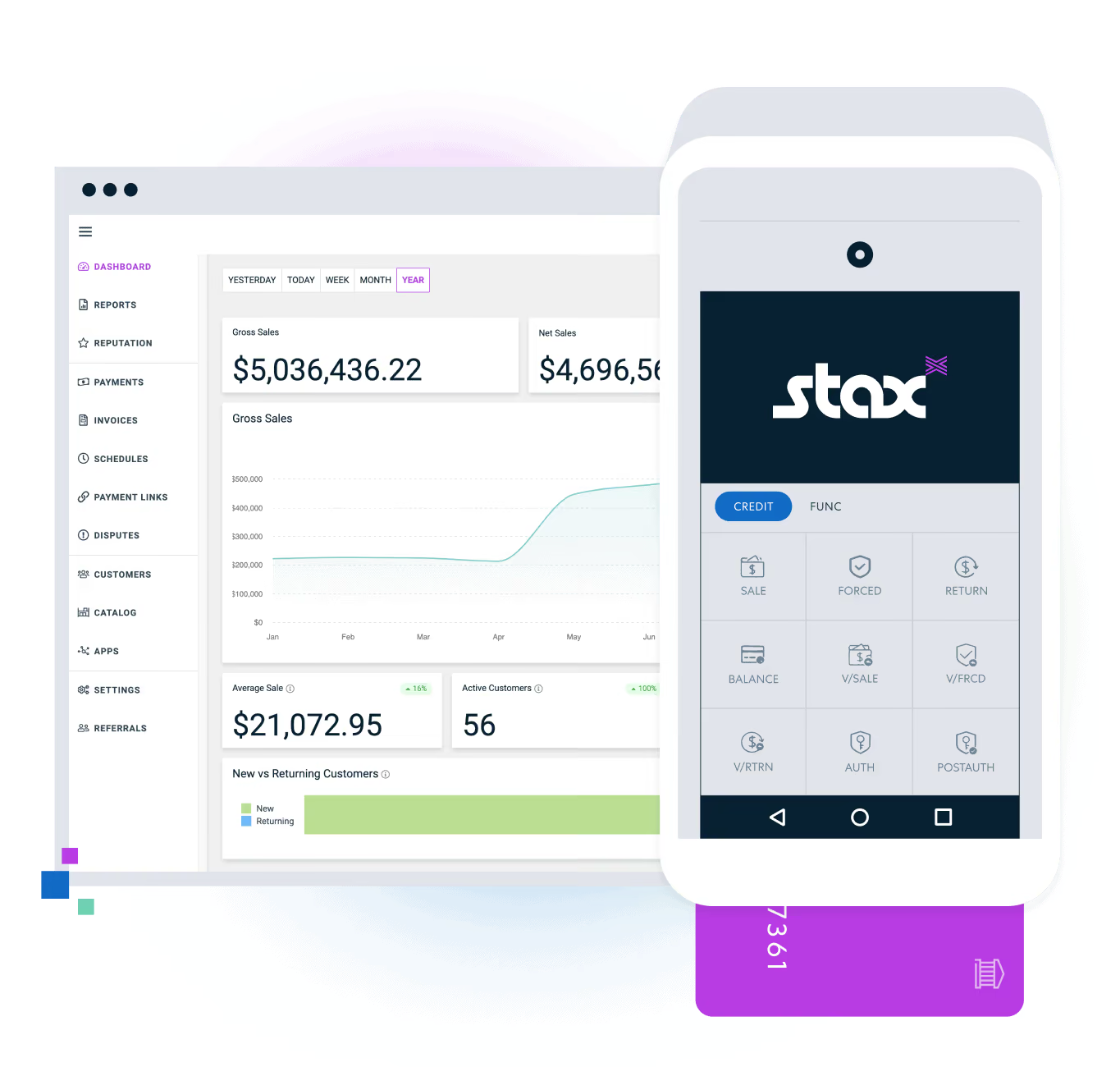
Stax (formerly Fattmerchant) pioneered the subscription payment model. Their philosophy is simple: they don't penalize you for being successful. Whether you process $30,000 or $100,000, they make their money on the software subscription, not by skimming a percentage off your hard-earned sales.
The 2026 Fees:
Monthly Fee: Starts at $99/month based on volume
In-Person Transactions: Interchange + 0% markup + 8¢
Online Transactions: Interchange + 0% markup + 15¢
The Advantage: Infinite scalability. Once your volume is high enough to justify the monthly fee, your effective processing rate drops dramatically because you aren't paying a percentage markup to the processor.
The Drawback: The $99/month base fee covers basic processing. If you want their advanced software tools, like advanced recurring billing or higher-tier dashboards, you have to pay for upgraded software plans that can range from $49 to $129 extra per month on top of your base fee.
Best For: Established B2B companies, high-volume retail, and scaling medical/dental offices processing over $30,000 per month.
Stax is excellent for scaling SMBs, but if you are a multi-national franchise processing millions globally, you will need enterprise-grade infrastructure. Compare the global giants in our Adyen vs. Worldpay review.
The Break-Even Math: When Should You Switch?
To truly see which model saves you more, let's run the math on an online business with an average ticket size of $50. We will assume the base wholesale interchange rate is 1.8%.
Scenario A: $10,000/Month Volume (200 Transactions)
Stripe (Flat Rate): 2.9% + 30¢ = $290 + $60 = $350 total fees
Stax: $99/mo + (1.8% interchange) + 15¢ = $99 + $180 + $30 = $309 total fees
Helcim: $0/mo + (1.8% + 0.50% markup) + 25¢ = $0 + $230 + $50 = $280 total fees
Winner: At lower volumes, the subscription fee hurts you. Helcim saves you $29 over Stax and a massive $70 over Stripe.
Scenario B: $50,000/Month Volume (1,000 Transactions)
Stripe (Flat Rate): 2.9% + 30¢ = $1,450 + $300 = $1,750 total fees
Helcim: $0/mo + (1.8% + 0.50% markup) + 25¢ = $0 + $1,150 + $250 = $1,400 total fees
Stax: $99/mo + (1.8% interchange) + 15¢ = $99 + $900 + $150 = $1,149 total fees
Winner: At scale, the 0% markup dominates. Stax saves you $251 over Helcim and a staggering $601 over Stripe
While this guide focuses on wholesale models, many newer businesses start with flat-rate options. Read our full Stripe vs. Helcim vs. Square comparison to see if you are actually ready to make the switch.
Quick Comparison: Helcim vs. Stax (2026)
| Feature | Helcim | Stax |
|---|---|---|
| Pricing Model | Interchange-Plus | Subscription + Interchange |
| Monthly Fee | $0 | From ~$99/month |
| Transaction Fees | Interchange + 0.15% to 0.50% + 8¢-25¢ | Interchange + 0% + 8¢-15¢ |
| Best For | Low/medium-volume SMBs | High-volume SMBs (>$30k+) |
| Contract Length | Month-to-month | Month-to-month |
| Key Strength | Software included for free | Massive savings at high scale |
Customer Support and Contracts
The best news for SMBs in 2026 is that the days of being locked into deceptive 3-year processing contracts are mostly over.
Both Helcim and Stax operate on transparent, month-to-month agreements with no early termination fees. Additionally, both companies are highly rated for customer support. However, Helcim often gets slightly higher praise from smaller merchants due to their in-house Merchant Success team being readily available by phone to help with onboarding.
ScaleUp Tip
Do not let the allure of "0% markup" trick you into buying Stax if you don't have the volume to support it. If your sales fluctuate wildly, such as a seasonal business that does $40,000 in December but only $4,000 in July, the $99/month fee from Stax will drain your profits during the slow months. Helcim’s "pay only when you process" model is much safer for businesses with seasonal or unpredictable revenue.
FAQs
1. Which is cheaper, Helcim or Stax?
It depends entirely on your monthly processing volume. Helcim is mathematically cheaper for businesses processing under roughly $20,000 to $25,000 per month. Stax becomes significantly cheaper at higher volumes because their subscription pricing eliminates the percentage markup.
2. Does Helcim really have zero monthly fees?
Yes. Helcim only charges transaction fees when you actually make a sale, with absolutely no monthly subscription, setup, or cancellation fees.
3. Who should use Stax?
Stax is best for established businesses with consistent, high processing volume (over $30,000/month). At that level, paying a flat monthly fee to access direct wholesale interchange rates leads to much lower overall costs than paying a margin on every swipe.
4. Can you switch between Helcim and Stax easily?
Yes. Both companies offer straightforward onboarding and neither forces you into long-term contracts. If you start with Helcim and eventually outgrow their margin model, you can smoothly transition your business over to Stax without paying cancellation penalties.
